
Effective emissions management: ISO 14064 and ISO 14067
An important aspect of sustainability is the effective management and reduction of greenhouse gas emissions. Among the most commonly used tools used for this purpose, the GHG Protocol, IPCC reports and ISO standards. The following article takes a closer look at aspects of ISO 14064 and ISO 14067 which offer companies and organisations a consistent framework for identifying, measuring and reporting their carbon footprint at both organisational and product level.
These standards are part of the ISO 14000 family, covering a wide range of issues related to environmental management systems. The focus of these two standards is on greenhouse gas emissions, providing internationally recognised guidelines for measuring and reporting carbon footprint. Implementing these standards can bring a number of benefits to an organisation, such as:
- improving energy efficiency,
- increasing transparency and credibility,
- strengthening competitiveness,
- preparing for future regulation.
Differences in scope
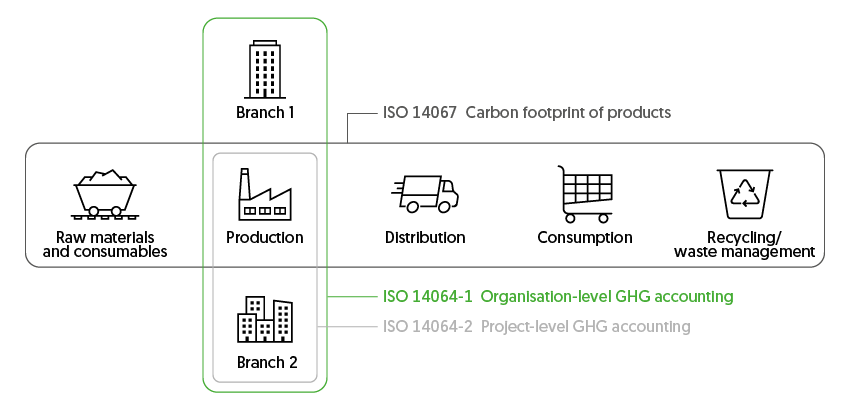
Both standards address the carbon footprint, but differ in scope. ISO 14064 focuses on managing greenhouse gas emissions at an organisational level, supporting the measurement, reporting and reduction of these emissions in a company-wide context. ISO 14067, on the other hand, addresses the carbon footprint of products, enabling the analysis of emissions across the life cycle of a specific product. In short, while ISO 14064 covers a broader organisational perspective, ISO 14067 focuses on specific impacts related to individual products.
ISO 14067: Carbon footprint of products
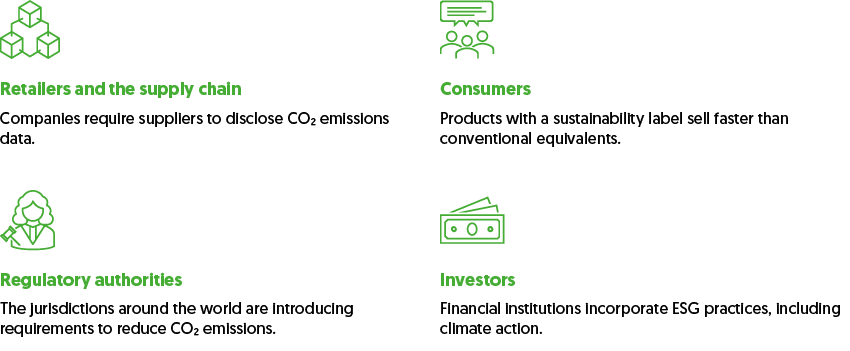
As environmental awareness grows, more and more companies are measuring the carbon footprint of their products in response to the expectations of various stakeholders. From retailers and the supply chain to consumers, regulators and investors, all these groups are putting pressure on companies to be transparent about their CO2 emissions.
ISO 14067 focuses on the measurement and reporting of the lifecycle emissions of a product. It covers both direct and indirect emissions associated with all stages of the supply chain, including raw materials and consumables, distribution, consumption and disposal. It can be applied to both physical products as well as services, making it a versatile tool for sustainability.
Measuring a product’s carbon footprint allows companies to identify emission-intensive processes and take action to optimise them, leading to cost reductions and increased operational efficiency. By following the ISO 14067, organisations can also benchmark their performance against others in the industry, which promotes increased competitiveness and innovation.
Not only does the standard support companies to better understand their impact on climate change, but it also enables them to develop strategies to reduce greenhouse gas emissions. As a result, companies can implement measures to improve energy efficiency, use renewable energy sources and introduce more sustainable practices throughout their supply chains.
ISO 14064: The carbon footprint of an organisation
ISO 14064 focuses on the management of greenhouse gas (GHG) emissions at the organisation level. It is divided into three parts, each focusing on a different aspect of emissions management:
The carbon footprint of the organisation
The first part of the standard, ISO 14064-1, focuses on the organisational level, offering the creation of accurate GHG emissions statements. This part of the standard is crucial for increasing stakeholder confidence and for preparing organisations to comply with future environmental regulations. Properly prepared statements enable a more accurate understanding of an organisation’s performance in terms of emission sources and the identification of areas with potential for improvement.
The carbon footprint of a project
The second part of the standard, ISO 14064-2, focuses on reduction projects, providing tools for planning, implementing and monitoring initiatives aimed at reducing emissions. By applying these guidelines, organisations can assess the effectiveness of their actions, leading to cost savings and improved operational efficiency.
Verification and validation
The final part of ISO 14064 (ISO 14064-3) provides a framework for the verification and validation of emissions data and reduction projects. The introduction of verification processes is essential to maintain the reliability of data and reports, which is key to building trust among stakeholders.
Together, these three parts of the ISO 14064 create a comprehensive framework for carbon footprint management system that supports organisations in their pursuit of sustainability and environmental responsibility.
Managing greenhouse gas emissions is key to the sustainability of any organisation. ISO 14064 and 14067 standards enable accurate measurement, reporting and optimisation of emissions, benefiting both companies and the environment. Implementing these standards is a step towards greater efficiency, transparency and environmental responsibility.
If you would like to find out more about the carbon footprint contact our experts. Greeners’ specialists are experienced in calculating GHG emissions, managing them and implementing effective reduction measures.
May 6, 2025
Recent news
Zmiany w wytycznych Komisji Europejskiej: Nowa perspektywa dla sektorów energochłonnych – rekompensaty sektorowe
Komisja Europejska znacząco zaktualizowała zasady przyznawania rekompensat sektorowych za koszty pośrednie CO₂. Zmiany te otwierają drogę do systemu wsparcia dla nowych branż oraz podnoszą poziom pomocy dla dotychczasowych beneficjentów. Dla wielu przedsiębiorstw może to oznaczać możliwość uzyskania wsparcia po raz pierwszy lub zwiększenie dotychczasowego poziomu rekompensaty.
Rekompensaty sektorowe: Lista sektorów objętych wsparciem i sektorów planowanych do objęcia
W grudniu 2025 roku Komisja Europejska zaktualizowała wytyczne dotyczące pomocy państwa, rozszerzając listę kwalifikujących się branż o 20 nowych sektorów i 2 podsektory. Nowe branże nie są jeszcze objęte wsparciem w Polsce – Polska ma czas na implementację zmian do prawa krajowego do 30 czerwca 2026 roku. Poniżej przedstawiamy kompletne zestawienie sektorów już objętych rekompensatami oraz tych, które zostaną nimi objęte po wdrożeniu nowych przepisów.
Nowe wytyczne Komisji Europejskiej: Co zmieni się w systemie rekompensat sektorowych w 2026 roku?
Komisja Europejska zmieniła wytyczne dotyczące niektórych środków pomocy państwa w kontekście systemu handlu uprawnieniami do emisji gazów cieplarnianych po 2021 r., co radykalnie zmienia sytuację przedsiębiorstw z wielu sektorów energochłonnych, które dotychczas pozostawały poza systemem wsparcia rekompensat sektorowych.
Energy transition of your company
We specialize in implementing sustainable development solutions that deliver tangible benefits to our clients.